

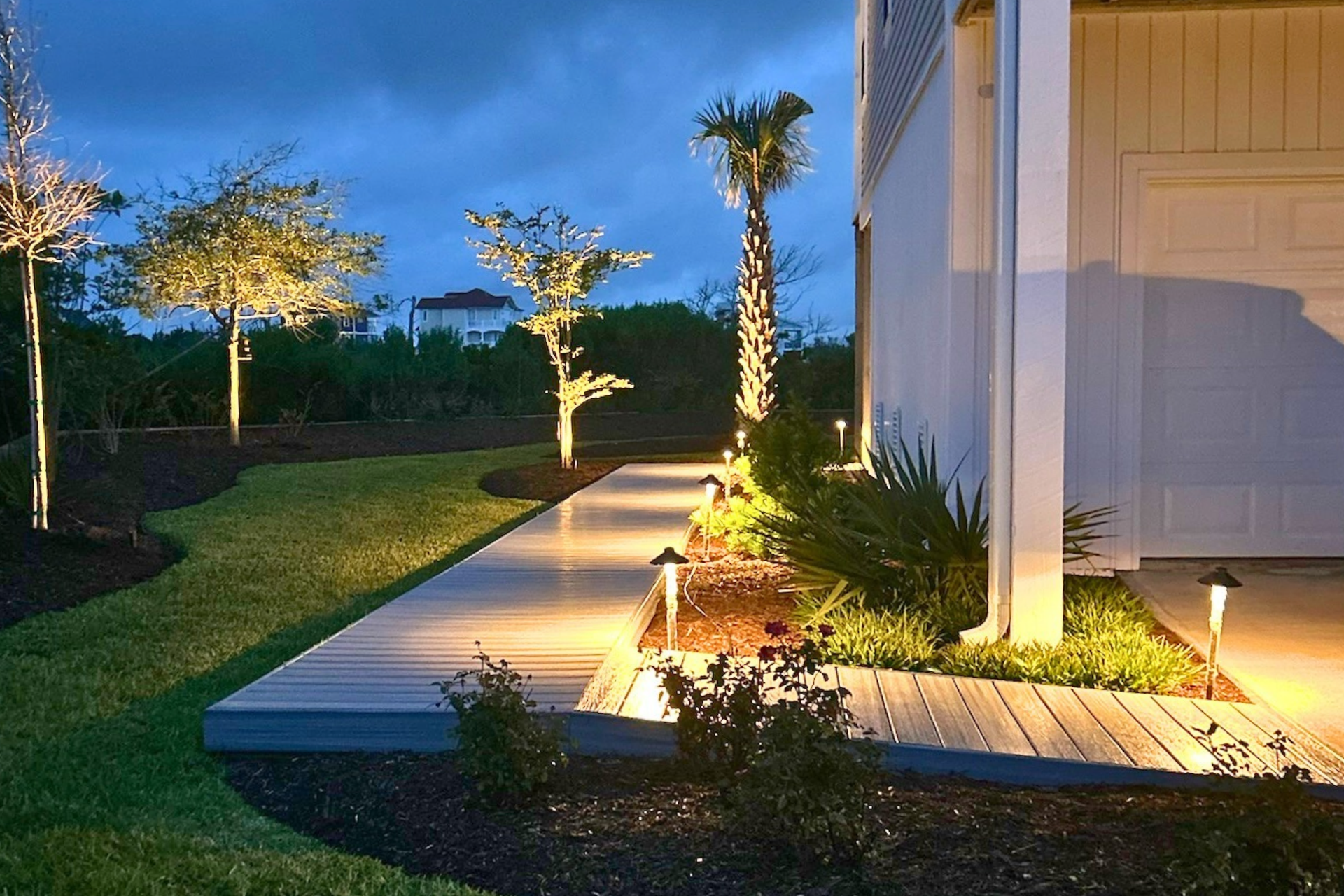
Now that the clocks have fallen back, it’s dark before most of us even pull into the driveway, and that’s exactly when landscape lighting earns its keep. Well-placed fixtures keep your home’s architecture, trees, and hardscapes on display after sunset, and since curb appeal plays a real role in how buyers value a home, that nighttime first impression matters more than most homeowners realize.
Soon, homes from Surf City to Topsail Beach will be glowing with holiday lights going up for the season. Those come down in January, but your home will still spend much of the winter being seen at night, and well-designed landscape lighting keeps it looking its best the whole time.
You don’t have to be selling to appreciate it, either. Under warm light, evergreen beds, palms, and the stonework around a patio take on a whole different character in the winter months, and with the sun setting so early, you’ll have plenty of evenings to enjoy the view.
What Does Nighttime Curb Appeal Mean?
Most people think about curb appeal in daylight terms: a healthy lawn, fresh mulch, a welcoming front door. But neighbors driving home from work, guests arriving for dinner, and buyers doing a drive-by after a showing often see your home after dark. Without lighting, even a beautifully landscaped yard fades into a dark outline once the sun goes down.
Nighttime curb appeal is about making sure everything you’ve invested in your home and landscape is still visible, and still inviting, after sunset. A home that looks great at 2 p.m. but disappears by 6 p.m. is only showing off half the time.
How Does Curb Appeal Affect Home Value?
More than most people assume. Research from the University of Texas at Arlington found that homes with strong curb appeal sell for an average of 7% more than comparable homes in the same neighborhood, and the premium grows in slower markets when buyers have more options to compare. Real estate agents see it, too. In the National Association of Realtors’ Remodeling Impact Report, 97% of Realtors said curb appeal is important in attracting a buyer.
Lighting doesn’t replace the basics, like a healthy lawn, a well-kept exterior, and thoughtful landscape design and installation. It extends them, so the curb appeal you’ve built during the day carries into the evening.
Which Lighting Choices Make the Biggest Impression?
Uplighting a mature tree or a cluster of palms is usually the single most striking addition. A couple of fixtures aimed up through the branches create a dramatic silhouette that anchors the whole front yard after dark. Soft light washed across the house adds depth and highlights architectural details like columns, stone, or trim that would otherwise disappear at night.
The entry and walkway are where looks and function meet. Lighting along the path and steps leading to your front door draws the eye straight to the entrance, and it makes the walk up safer for anyone arriving after dark. The goal is a layered, balanced look, with a few well-chosen focal points instead of every corner lit up.
Why Does Landscape Lighting Matter Most in Fall and Winter?
Here on the coast, the sun sets around five o’clock in the heart of winter, so for months at a time, the hours you’re home and awake are mostly after dark. That’s when your yard is either a dark patch or part of how your home welcomes you back each evening.
If you’re planning to sell, there’s a practical bonus too. Twilight photos, like those dusk shots where a house glows against a deep blue sky, are a popular way to market a home, and landscape lighting is what makes them work. Without it, the yard becomes a dark foreground in the very photos meant to show your home at its best.
Is Landscape Lighting Worth It Beyond Resale?
For most homeowners, the bigger payoff is how it feels to live with. In the same NAR report, landscape lighting earned a perfect 10 out of 10 Joy Score from homeowners, tying with an in-ground pool for the highest of any outdoor project. Lighting around a patio, fire feature, or outdoor kitchen also stretches how long you can actually use those spaces, turning your outdoor living space into somewhere you’ll spend the evening instead of just the afternoon.
What Should Coastal Homeowners Keep in Mind?
Salt air is hard on outdoor fixtures, so material matters. Professional-grade, weather-resistant fixtures hold up to salt, humidity, and winter rain far better than lower-grade options, which tend to corrode quickly near the ocean. Pairing those fixtures with low-voltage LED lighting on a timer keeps the system efficient and hands-off.
A lighting design also evolves with your yard. As trees fill out and beds grow in, fixtures may need re-aiming, and plantings may need trimming so they don’t block the light, which is easy to handle as part of a regular landscape maintenance plan.
If you’re oceanfront in Surf City or Topsail Beach, good design also accounts for sea turtle nesting season, when lighting visible from the beach should be shielded and aimed away from the dunes. Planning for that from the start means your lighting can run year-round without working against local ordinances or the turtles.
Show Off Your Home After Dark With Topsail Outdoor Living
At Topsail Outdoor Living, we design and install landscape lighting for homes across Surf City, Topsail Beach, and Hampstead, with fixtures built for coastal conditions and layouts designed to bring out the best in your home and landscape. Schedule a consultation, and we’ll walk your property with you to plan a lighting design that makes your home look as good at night as it does during the day.
Frequently Asked Questions
-
Curb appeal has a measurable effect on sale price, and lighting is one of the ways to extend it into the evening. How much it adds depends on your home, your market, and the quality of the design, but a well-lit home makes a stronger first impression on buyers.
-
Start with the front entry and the walkway leading to it, then add one or two focal points like a mature tree or the face of the house. Those few elements make the biggest difference in how your home reads from the street.
-
Not if it’s designed well. Good landscape lighting uses warm tones, softer light, and a few carefully placed focal points, so the home glows rather than glares.
-
Not usually. Modern systems use low-voltage LED fixtures that draw very little power, and a timer keeps them on only during the evening hours when you actually want them.
-
Yes. Lighting can be designed around your existing beds, trees, and hardscape, with wiring run below grade so the fixtures blend into the landscape instead of standing out.